
Consumption Is Just Another Addiction
Why smart people stay stuck—and how to become your own bully


One Big Idea
We mistake consumption for progress. Courses, research, and preparation all look like “productivity,” but often they’re just avoidance with invoices, procrastination parading as being productive. Sometimes a bit of bullying can be useful, but you’re going to have to be your own bully.
The Far-Too-Expensive Education That Taught Me Nothing
I do all the wrong things, like starting my day with warm salt water and twenty minutes of meditation.
You’re supposed to drink that half-liter slowly, and you want to be comfortable for meditation. That half-liter of warm salt water means there’s a poo looming in your future, so naturally, I check my email. Who among us has pooped without a phone in the last decade?
Let whoever is without a smartphone on the toilet cast the first stone.
I buy a fair number of courses, so I’m on a fair number of email lists.
Happily, meditation works. Captive audience that I was, I noticed the impulse to buy yet another course, another promise of transformation.
I made coffee.
I opened my journal.
And I wrote.
I wanted to write about how to stop buying courses.
But at the end of this email, I’ll recommend a course to buy.
And here’s why: this isn’t the essay I wanted to write. It’s the article I needed to write. That was an act of discovery that resulted from an act of excavation. And both those happened using an AI tool and thinking framework I created.
I realized 2 important things:
For me, buying courses displays addictive behavior I thought I had conquered long ago. (I did, but now it manifests itself in “productivity,” which is just another way to assuage the same anxieties and sense of insufficiency that craft beer used to handle).
The framework I’d created was working on myself on a metacognitive level — I was seeing it in action, and I was excited.
Smart people often get stuck because smart people are often addicts. And sometimes smart people fool themselves (and the ones around them) that consuming information is the same thing as learning. Then they get into a cycle of overconsumption and underproduction.
This isn’t the essay I wanted to write. But it’s much more useful to me than what I thought I was going to create.
Smart People Are Really Good at Disguising Addiction as Ambition
Look at your bookshelf. If it’s anything like mine, there are more unread books than finished ones right beside a stack you bought but will never read.
Don’t get me started on my Kindle. A digital graveyard for “future me.”
Graduate students know this pattern better than anyone. Humanities doctorates—liberal arts PhDs—take forever. According to the American Academy of Arts and Sciences, the median time to completion for a U.S. humanities PhD is about 6.8 years, often stretching past eight when you count from the bachelor’s degree. In Canada, it’s slightly better: most humanities doctorates take five to six years, according to University Affairs and York University data.
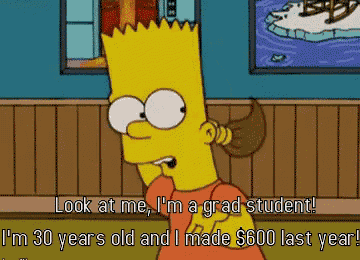
But that’s for people who finish. Many don’t. They run out of funding, steam, or both. I’ve watched people go fifteen years deep into a dissertation that will never be submitted.
The pattern is clear: consuming without producing; reading without writing; collecting without creating.
Then I looked at my bank statements.
A LOT spent on courses, nothing earned back, zero ROI.
I’m still an addict, just with acceptable branding.
If you read Substack, chances are you write on here, too.
At the very least, you create. Somehow, somewhere, you create something.
And you probably do so because you have good taste.
Here’s Ira Glass on the subject:
Nobody tells this to people who are beginners, and I wish someone told me. All of us who do creative work, we get into it because we have good taste. But there is this gap. For the first couple years you make stuff, it’s just not that good. It’s trying to be good, it has potential, but it’s not. But your taste, the thing that got you into the game, is still killer. And your taste is why your work disappoints you. A lot of people never get past this phase, they quit. Most people I know who do interesting, creative work went through years of this. We know our work doesn’t have this special thing that we want it to have. We all go through this. And if you are just starting out or you are still in this phase, you gotta know its normal and the most important thing you can do is do a lot of work. (Emphasis mine)
I have one specific person in mind, to whom I say, This is the trap you’re in.
If you love consuming culture — and have done so for a while — you’ve developed good taste. And, however closeted, a desire to produce something great yourself. But we want our output to match our taste immediately, so we stay in “learning mode” where we can’t be judged.
It’s safe there.
Be Your Own Bully
The safety is what’s killing you.
But since you’re safe, no one who cares about you is going to save you.
Your family are too close.
Your friends are not your therapists.
And strangers are too democratic to care about you any more than any other stranger.
So you’re going to have to bully yourself.
Not with cruelty, though. What you need is ruthless clarity. The kind of self-bullying that delves deep into behaviors and excavates the deep-rooted “why” behind its deceptive outward performance of “what.”
This essay exists because I caught myself doing it again— almost buying another course instead of building something.
I stopped. Dumped my thoughts. Excavated the idea. Focused. Shipped.
Conclusion
What’s the thing you keep “preparing” to do?
Stop preparing. Ship something ugly. Ship it ugly. Be okay with judgment.
In fact, welcome the judgment. I don’t even know what I want, so why should I pretend to know what other people want or what’s useful?
Ship it. Let people tell you. Then refine.
No one else is coming to push you. But you need not be afraid of shipping early because no one is coming to bully you, either.
Which means there’s an opening for the position. Be your own bully.
P.S. — The Irony Isn’t Lost on Me
I just spent 1,200 words telling you to stop buying courses, then I’m about to recommend one.
Here’s the thing: I wouldn’t be here writing this, building frameworks, getting promoted without that egads-ignore-this-if-you’re-reading-Mum-priced education in what not to do. The consumption wasn’t wasted. It taught me the pattern. But you don’t need to spend what I spent to learn what I learned.
If there’s one course I actually recommend, it’s this one: ChatGPTMastery.
Full disclosure: that’s an affiliate link. Hell, I have to try and get some ROI on this whole education.
I bought it because the same email copywriter who almost got me that morning was promoting it last year. His testimonial is on the sales page. I messaged him directly. He said it was great.
A year later, I’ve built products that have directly impacted my life—job promotions, career positioning, tangible results. Not because the course “transformed” me, but because it taught me how to use AI to build things immediately. Not prepare. Not research. Build.
So if you’re going to buy one more thing, make it count. Then ship something with it.